The late 1800s and early 1900s saw Manaus boom hectically on the back of the rubber trade and briefly become the richest megacity in the world. It never formally claimed that title, but its abrupt wealth, imported luxury living, and the name Paris of the tropics assisted in the development of the myth. Manaus is currently a pivotal mecca of the Amazon region, even though its heyday in the rubber trade has long passed.
Introduction
Have you ever studied how the megacity of Manaus in the Amazon wilderness was, at one time, the wealthiest megacity in the world? It peruses like a motion picture, however it has its establishments in a veritably truthful, strict period. This concept is what attracts contemporary readers, as it combines geography, money, and a sort of boom-and-bust drama that seems familiar even today. In this article, we will unravel what actually transpired, the existence of rich Manaus in the real sense, and the relevance of this story.
What is Manaus?
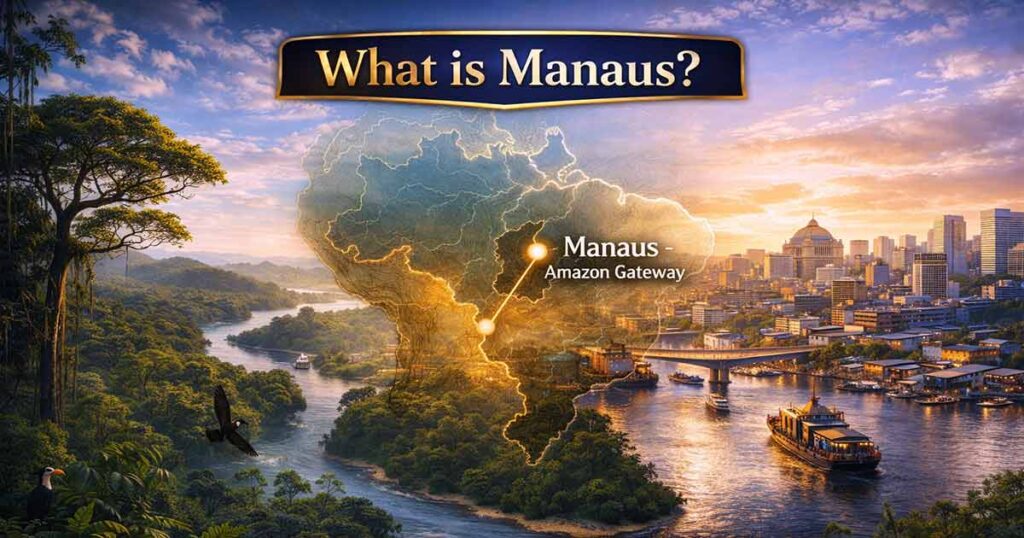
Manaus is a medium- sized megacity in northern Brazil that’s located at the point of the joining of the Rio Negro and the Amazon River. It’s the capital of the Amazonas state and the greatest megacity of the entire Amazon region. Due to its position, Manaus serves as a door to the thick rainforest and to the rest of the transport organization in Brazil.
Why Manaus matters
- It’s a major harbor and coordination center for moving products into and out of the Amazon.
- It bolsters neighborhood communities, research, and tourism in one of the world’s most critical ecosystems.
- Economically, it’s tied to commodities such as elastic, timber, and, more recently, gadgets and manufacturing in the Free Financial Zone.
Manaus isn’t a fair or inaccessible wilderness town. It’s a working city that interfaces nature, exchange, and present-day life in a way that still feels unusual compared to European capitals or huge coastal cities.
The Rubber Boom and Manaus’ Rise
In the late 1800s and early 1900s, the world all of a sudden required a parcel more elastic. Unused developments like bikes, cars, and phones all utilized elastic for tires, cables, and seals. At that time, the Amazon rainforest was the only real source of high‑quality natural rubber, and Manaus sat at the heart of that trade.
Global demand for rubber
- Industrial growth in Europe and North America created a rubber gold rush.
- Brazil controlled the best rubber‑producing trees, and Manaus became the fundamental collection and shipping point.
- Rubber aristocrats (wealthy dealers and landowners) built fortunes nearly overnight.
How Manaus became a hub
- Vendors in Manaus bought elastic from neighborhood collectors and transported it to Europe and the US.
- The city developed from a little waterway town into an active harbor with banks, lodgings, and European‑style shops.
- Because of its position on the Amazon, Manaus became the affluent center of a whole rubber‑rich region.
This is why Manaus was so wealthy in the past? begins to make sense. It wasn’t built on a broad modern economy; it rode a single, powerful resource wave.
Was Manaus Really the Richest City in the World?
The thought that Manaus was the wealthiest city in the world is more of an emotional story than a difficult truth. In fact, rubber‑rich families in the city lived amazingly well for the time, but there’s no strong worldwide positioning that demonstrates Manaus beats New York, London, or Paris in add up to riches.
What might the richest city have meant
- Some people measured wealth by how rich the local elite looked, not by GDP.
- Others pointed to per‑capita income within the rubber‑rich class, which could have been very high.
- Official city‑by‑city economic data from the 1800s simply doesn’t exist in the way we have today.
Comparing Manaus to other cities
| City | Era (approx.) | Main economic driver | How it compares to Manaus at the time |
| Manaus | 1890s–1910 | Amazon rubber trade | Very rich for a regional city, but small and remote |
| London | 1890s–1910 | Empire, finance, trade | Already a global financial capital |
| New York | 1890s–1910 | Industry, shipping, finance | Much larger and more diversified |
| Paris | 1890s–1910 | Culture, fashion, industry, trade | Deep‑rooted wealth and global influence |
So, while Manaus felt like the richest place in the Amazon, the richest city in the world is an exaggeration rather than a record‑book title.
Signs of Extreme Wealth in Manaus
If you stood in Manaus amid its rubber‑boom prime, the city didn’t seem like a destitute wilderness station. It looked more like a tropical form of a European capital, which is why individuals still call it Manaus, the Paris of the tropics.
The Amazon Theatre as a symbol
The Amazon Theatre (Teatro Amazonas) is an incredible, melodious show house built in the late 1800s.
The Italian marble, French chandeliers, and imported tiles give an idea of how much money was poured into the city.
More articles about its story can be found in the BBC’s coverage of Manaus‘ economic rise and its social interface. It is still a major tourist attraction.
Imported luxury and European‑style buildings
- Well-off neighborhood individuals bought plans, furniture, and advancements imported from Europe.
- The streets of the city center are lined with extravagant buildings, cafes, and shops that make it feel like a tropical port, a European city.
- These points of interest are why the state of Manaus, Paris of the tropics, is stuck in travel composing and history pieces.
All of this fed the idea that Manaus was living like a world‑class city, even though it was floating in the middle of the Amazon.
Why Manaus’ Wealth Didn’t Last
Rubber wealth in Manaus didn’t fade slowly; it crashed. The cause had little to do with the city itself and everything to do with global competition and bad luck.
Seeds smuggled out of the Amazon.
- How rubber tree seeds were brought from Brazil by a British pioneer, Henry Wickham, in the late 1800s.
- The seeds taken from Brazil were planted in British colonies in Asia, particularly in Malaysia and Sri Lanka.
- Within a few decades, Asian ranches may deliver elastic more cheaply and dependably than the wild Amazon trees.
The collapse of Amazon‑based rubber dominance
- Prices for Amazon rubber dropped as Asian plantations flooded the market.
- Manaus lost its near‑monopoly on high‑quality natural rubber.
- Many rubber‑rich families saw their fortunes dry up, and the city’s economy shrank sharply.
The lesson here is basic: an economy built on one asset can rise quickly and drop just as quickly when the world finds a cheaper or less demanding alternative.
Manaus Today: From Rubber Gold to Modern Economy
These days, Manaus is no longer a rubber‑only city. In steps, its economy has moved to a more progressive mix of industry, trade, and services.
The Free Economic Zone
- The Free Financial Zone of Manaus (Zona Franca de Manaus) was established in the 1960s to draw in manufacturing plants and jobs.
- It gives tax breaks and trade‑policy advantages for companies that set up there.
- Electronics, appliances, and parts for the automotive and tech industries now form a big part of Manaus economy today.
Living standards now vs. the rubber‑boom era
- Nowadays, individuals in Manaus bargain with commonplace modern‑city issues: activity, cost of living, and inequality.
- Average earnings are distant from what the rubber‑rich first class once had, but the city bolsters a broader middle class.
- New businesses in Manaus economy nowadays are more steady than during the ancient rubber‑boom days, indeed, if it’s not as flashy.
Manaus still feels like an extraordinary place, but it’s presently a working Amazon‑region city, not a short‑lived wealthiest city in the world.
The Richest City Myth Versus Reality
The thought that Manaus was the wealthiest city in the world is an effective myth. It blends a genuine rubber‑boom truth with misrepresentation, nearby pride, and constrained information.
How the myth grew
- Guests in the late 1800s and early 1900s were astounded by the musical drama house, imported products, and wealthy lifestyles.
- Newspapers and travel journalists rehashed the richest city line without checking worldwide statistics.
- Over time, local people and visitors kept retelling the story as truth.
Why the myth survives
- The story is as well sensational and abnormal to ignore.
- It fits into travel showcasing and history articles, which frequently rehash the claim without double‑checking.
- You’ll still see references to Manaus, Paris of the tropics, in advanced guides and highlights, citing pages like the Manaus Wikipedia entry.
In brief, the myth is for the most part a picture and narration, not around official financial rankings.
Why This Story Matters for Business and Economies
The rise and fall of Manaus is a perfect example of what happens when a place depends almost entirely on one resource. It’s like a sports team that wins every season with one superstar player or a tech company that rides one hit product for years.
Boom‑and‑bust cycles
Rubber created a classic boom‑and‑bust cycle: fast money, then quick collapse when the market shifted.
Modern cities reliant on oil, mining, or tech can face similar risks if they don’t diversify.
When a single industry slows down, just like the sudden impact of major app changes in the tech world, the whole local economy can feel the shock.
Lessons for today’s economies
Always try to spread your income across different industries, not just one magic product or resource.
Watch global trends closely, just like Asian rubber plantations changed Manaus’ fate, new competitors can change modern markets fast.
Utilize short‑term booms to construct long‑term foundation, instruction, and aptitudes, not just extravagant buildings.
Manaus’s story is an update that riches built on one thing can vanish rapidly if the world changes.
How to Explore Manaus for a Curious Business‑Minded Reader
If you’re perusing this and considering approximately travel, financial matters, or trade thoughts, Manaus offers more than fair wilderness photographs. It’s a living case to think about in boom, bust, and rehash.
Visit the Amazon Theatre and the historic district
The Amazon Theatre and surrounding streets show what the rubber‑boom era looked like.
Walking through the area gives you a sense of how a small city can suddenly feel rich and global.
It’s a good mental reference point when you read about modern boom cities or tech hubs.
Learn about the Free Economic Zone
The Free Economic Zone of Manaus is a real‑world example of how tax policy and trade rules can attract factories.
Look into which industries are growing there now, such as electronics and parts supply chains.
This makes a difference; you get it how a city can switch from a natural‑resource economy to a more mechanical one.
Talk to locals about business and investment
Nearby guides, commerce proprietors, or lodging staff can share commonsense bits of knowledge about Manaus economy today.
Ask approximately challenges such as transport, vitality, and competition.
These discussions can start thoughts around how other districts might dodge the same boom‑and‑bust pattern.
It becomes a matter of life and death how economies rise, fall, and change; it becomes more than just a travel destination for a curious, entrepreneurial mind to think about.
FAQs
Was Manaus truly the wealthiest city in the world at any point?
There is no solid record around the world that illustrates Manaus was definitively the wealthiest city in the world. It was amazingly well off for its estimate and locale amid the elastic boom, but major cities like London, New York, and Paris had much larger economies and more diverse industries.
When did the elastic boom happen in Manaus?
The elastic boom in Manaus crested generally between the 1880s and 1910s. During this time, the city developed quickly, and the rubber‑rich tip top lived in extravagance. The boom blurred after Asian elastic manors began to rule the worldwide market.
Why did elastic generation in the Amazon collapse?
Rubber generation in the Amazon collapsed since seeds were smuggled out and planted in British colonies in Asia. Ranches in places like Malaysia and Sri Lanka seem to create elastic more cheaply and dependably than the wild Amazon trees, which pushed Manaus’ elastic exchange to the margins.
Is Manaus still a financially imperative city today?
Yes. Manaus is still a critical financial center in northern Brazil, particularly appreciated for the Free Financial Zone and its role as a harbor and exchange center for the Amazon region. Whereas it’s not as inclusive as it was during the economic boom, Manaus economy nowadays still supports numerous businesses and jobs.
How did an inaccessible Amazon city bear rich buildings like the Amazon Theatre?
The Amazon Theater and other extravagant buildings were financed by rubber‑rich vendors and landowners who made gigantic profits from the worldwide rubber trade. Imported materials and European‑style plans made a difference in making the picture of Manaus, Paris of the tropics, indeed, even though most standard individuals did not share that wealth.
What can Manaus’ story instruct us about present-day commerce booms?
Manaus educates us that depending on one item, asset, or industry can be hazardous. When the world finds a cheaper or superior alternative, the boom can conclude rapidly. Expanding wage sources, contributing to aptitudes and foundation, and observing worldwide patterns are key to staying away from a comparative crash.
How does Manaus compare to other affluent South American cities now?
Today, Manaus is littler and less well off than major South American cities like São Paulo or Buenos Aires. In any case, it remains a critical territorial capital in the Amazon, with a blend of industry, trade, and services that keeps it pertinent. Its economy is steadier than during the rubber boom long ago, but not as flashy.
Is there strong information demonstrating Manaus was wealthier per capita than London or Modern York?
There is no solid, modern‑style information that demonstrates Manaus had a higher per‑capita salary than London or Unused York amid the elastic boom. Claims that Manaus is the wealthiest city are more often than not based on anecdotal evidence and hearsay, not on point-by-point financial records.
Why does this richest city story still show up in travel and history articles?
The wealthiest city’s story is sensational and unusual, which makes it a subject for travel writing and history pieces. It fits the picture of Manaus, Paris of the tropics, and makes a difference in drawing readers’ consideration. Numerous articles rehash the claim without checking the full financial picture, which keeps the myth alive.